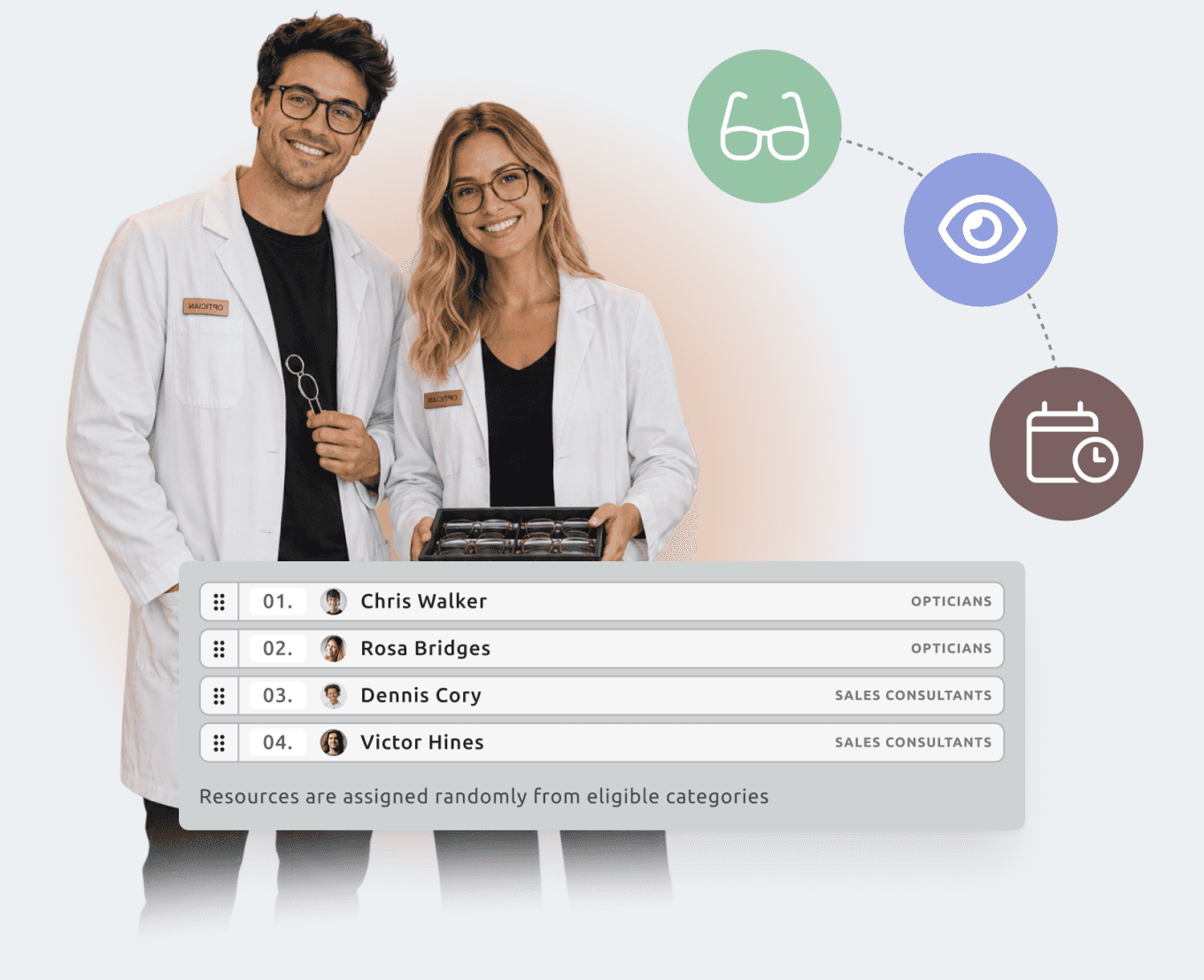
For many businesses, increasing appointment capacity seems to come down to one question: do we need more staff?
But often, the real constraint is not the number of resources available. It is how those resources are scheduled.
Two employees may be qualified to deliver the same service, but one can complete it faster. A specialist may be able to perform a simple appointment, but their time would be better protected for more complex work. A consultation might need not only an employee, but also a specific room or piece of equipment.
When a scheduling system treats all of these resources as interchangeable, valuable capacity can remain hidden.
That is where smarter resource scheduling changes the equation.
With TIMIFY, businesses can combine resource dependencies, individual availability, resource prioritisation and resource-based service duration to decide not only who can deliver a service, but who should deliver it when several options are available.
And there is one principle at the centre of it:
Every eligible resource stays selectable. Your business priorities govern automatic assignment.
Consider a multi-location optical business.
At one location, several employees are qualified to perform the same eye examination. Every appointment also requires an examination room and specific equipment.
From the customer's perspective, it is one service.
Operationally, however, there is much more going on behind the booking.
One employee may need 45 minutes to complete the examination. A more experienced colleague may be able to perform the same service in 30 minutes. Another specialist should ideally remain available for more complex consultations.
At the same time, the examination cannot take place unless the correct room and equipment are available.
Simply asking, "Who is free?" is no longer enough.
The business actually needs to answer several questions simultaneously.
Which employee should be assigned first? Which resources should remain available as fallback? How long does this particular resource need for the service? Is the required room available at the same time? And what happens if the customer wants to book a specific employee?
At scale, these decisions have a direct impact on appointment availability, resource utilisation and how consistently services are delivered across locations.
TIMIFY treats a resource as more than just a member of staff.
Employees, consultation rooms, machines, devices, vehicles and other assets can all be managed as resources and connected to the services that require them.
This means an eye examination can be configured to require an eligible employee and an examination room. A diagnostic appointment could require a clinician and a particular device. A retail consultation might require an advisor and a consultation area.
TIMIFY calculates availability around those dependencies, so an appointment is only offered when everything required to deliver it is available.
That forms the foundation.
Resource Prioritisation then adds another layer: when several eligible options exist, TIMIFY can determine which one should be preferred.
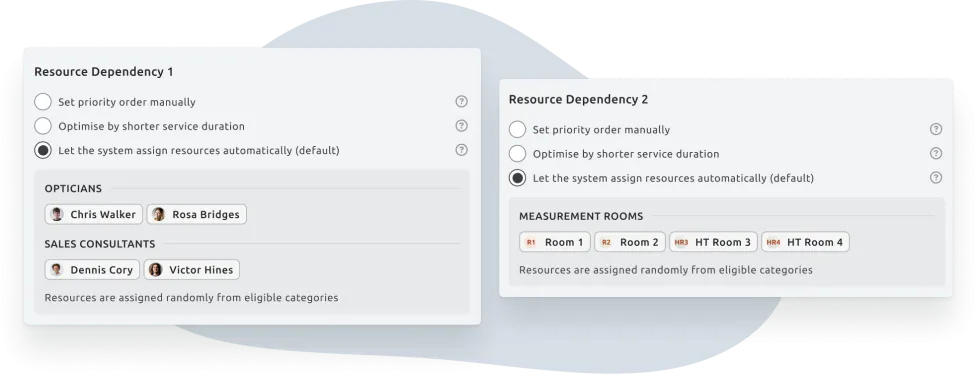
There are different reasons why one resource might be preferable to another.
Sometimes the goal is to protect scarce expertise.
For a standard consultation, a business may want junior or generalist employees to be assigned first, keeping senior specialists available for appointments where their expertise is genuinely required.
In that case, a fixed priority order makes sense.
The preferred resource is checked first. If that resource is unavailable for a particular time slot, TIMIFY can move to the next eligible option.
For another service, the business objective may be completely different.
The priority might be capacity.
If one qualified employee can perform a service in less time than another, prioritising that resource can create additional booking opportunities throughout the day.
That is where resource-based service duration becomes especially powerful.
A service does not necessarily take the same amount of time for every person who delivers it. Experience, specialisation, equipment or internal processes can all affect how long a resource needs.
Instead of forcing every eligible resource into exactly the same operational duration, TIMIFY can use a shorter effective service duration for resources that can complete the appointment faster.
Imagine the standard duration of a service is 45 minutes.
One employee needs the full 45 minutes. Another consistently performs the same service in 30 minutes.
When duration-based prioritisation is enabled, TIMIFY can prefer the faster resource when calculating availability.
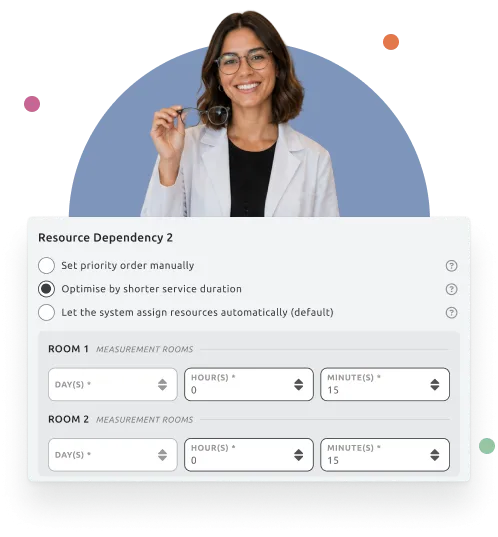
If that resource is unavailable for a particular slot, another eligible resource remains available as a fallback.
The result is not a different service catalogue for every employee. It is smarter use of the capacity behind one service.
The base service duration remains the reference for how slots are presented, while the effective duration of the selected resource determines the actual booking length and calendar capacity.
That distinction can unlock appointment availability that a scheduling system based only on fixed service duration would never expose.
Resource categories are a powerful way to manage organisations at scale.
A business might group employees into trainees, advisors and specialists, or organise physical resources into consultation rooms, diagnostic devices and treatment areas.
When the business rule applies to the whole group, prioritising the category is the logical approach.
But enterprise resource structures are not always category-based.
In many organisations, workforce management, ERP or other external systems assign services directly to specific employees or resources. In those environments, requiring the business to restructure everything into categories just to influence booking priority adds unnecessary complexity.
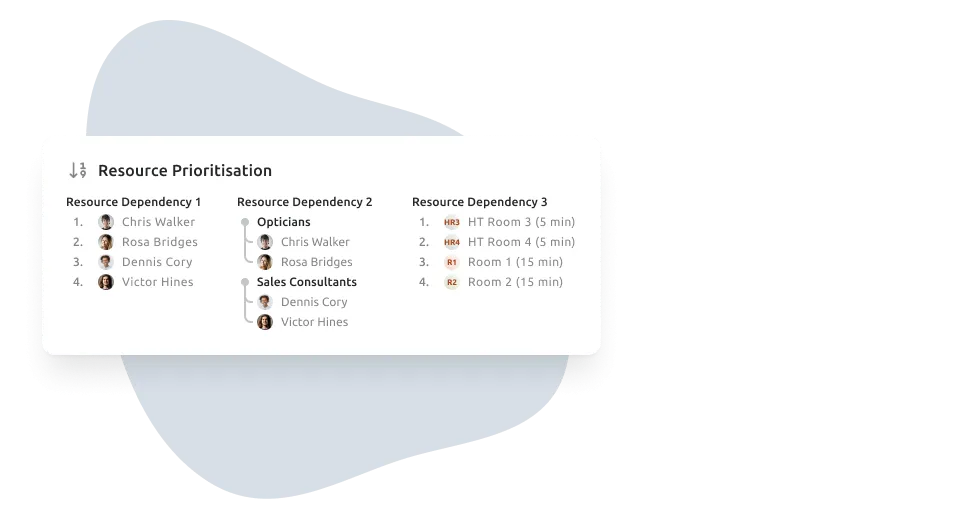
TIMIFY's Resource Prioritisation can therefore also operate at the individual-resource level when a service dependency contains specific resources.
The scheduling logic follows the way the service is actually configured.
Category-based setup? Prioritise the categories.
Specific-resource setup? Prioritise the individual resources.
This makes the same scheduling logic usable across very different operational and integration models.
Complex services often depend on more than one type of resource.
The employee may be one requirement. The room another. Equipment may be a third.
TIMIFY evaluates resource requirements individually, which means the scheduling strategy does not have to stop at staff assignment.
A business could use a preferred order for employees while separately managing which room or equipment category should be used.
This is particularly relevant for organisations where the true bottleneck is not always the person delivering the service.
A specialist machine, examination room, fitting area or consultation space can determine just as much appointment capacity as staff availability.
Resource optimisation therefore becomes a service-level question rather than simply an employee-distribution problem.

Scheduling platforms often face an apparent trade-off.
Either the system controls assignment automatically, or the customer chooses who they want.
TIMIFY takes a hybrid approach.
When a customer chooses any available resource, the configured prioritisation determines how availability and automatic assignment are handled.
When a customer deliberately selects a specific eligible resource, that choice is respected.
Prioritisation does not hide qualified alternatives from the customer.
It influences the decision only when TIMIFY needs to make the choice automatically.
For businesses, that means operational rules can work in the background without removing customer autonomy from the booking journey.
Prioritisation becomes even more valuable when it is combined with the wider resource-management capabilities behind it.
Each TIMIFY resource can have its own working hours and online booking availability. Shift Planner can reflect changing schedules, holidays, sick days and other blockers. Resources can be organised into categories, given individual permissions and connected through dependencies.
For employees working across several locations, Cross-Account Sync can help prevent the same person from being booked simultaneously in different accounts.
Multi-location organisations can use the Branch Manager to manage services and settings across their network, while integrations and the TIMIFY Developer Platform allow resource data to be connected with external business systems.
The result is not simply a calendar with available employees.
It is a scheduling model that understands the operational conditions under which a service can actually happen.
The first benefit is more usable capacity.
If certain resources can deliver a service faster, the scheduling logic can make use of that difference rather than forcing every appointment into the same operational pattern.
The second is better use of expertise.
A defined priority order can protect specialists from being consumed by appointments that other qualified resources could handle first.
The third is better utilisation of physical resources.
Rooms and equipment become part of the same availability decision instead of being managed as an afterthought.
And finally, there is greater consistency.
Instead of employees or branches making the same resource-assignment decisions manually every day, the business can translate its operating model into repeatable scheduling rules.
Traditional automatic assignment is useful when resources really are interchangeable.
TIMIFY can still distribute bookings across eligible resources using the configured filling logic when that is what the business needs.
But increasingly, enterprise scheduling requires more than distribution.
It requires context.
Who is best suited to this service? Which resource should be protected? Which option creates the most capacity? Which room or device must be available? And when should the system fall back to another option?
Resource Prioritisation brings those decisions into the scheduling process itself.
Instead of treating every available resource as equal, businesses can make availability reflect the way their operation actually works.
Adding people, rooms or equipment is expensive.
Before increasing capacity physically, there is another question worth asking:
Are you making the best possible use of the resources you already have?
For organisations with multiple employees, skill levels, locations or physical dependencies, intelligent resource scheduling can uncover capacity that is already there.
By combining resource dependencies, flexible availability, priority rules and resource-based service duration, TIMIFY helps turn operational complexity into smarter booking decisions.
More importantly, it does so without forcing businesses to choose between efficiency and customer choice.
Every eligible resource remains available. Your business logic simply helps TIMIFY choose the right one when the customer does not.
Discover how TIMIFY can combine people, rooms, equipment and availability into one intelligent booking process.

Lukas embarked on his professional journey after earning a Bachelor and Master's degree in Learning Sciences and Educational Research and Management at Ludwig-Maximilians-Universität München. With hands-on experience across HR, recruitment, and educational roles—from tutoring to shaping hiring and organizational strategy at Limehome and Diakonie Rosenheim—he joined TIMIFY in a People & Culture capacity, where he now thrives as P&C Manager. Blending his academic background in learning systems with real-world HR initiatives, Lukas is dedicated to crafting an enriched workplace culture and employee experience at TIMIFY.