Tips & Resources

How TIMIFY helps Real Estate Agents streamline appointments across the property journey

By Lukas Alberter
Updated: Published:

Streamline real estate appointment scheduling with TIMIFY. Automate bookings, reduce coordination, and improve customer experience.


a woman standing infront of a laptop with a cup in her hand
Back

In real estate, timing is everything.

Whether someone wants to view a property, speak to an agent about selling their home, ask questions about a listing, or arrange a follow-up consultation, speed and convenience play a major role in how that interaction begins. The faster and easier it is to move from interest to appointment, the better the experience for everyone involved.

That is why appointment scheduling has become an increasingly important part of the digital real estate journey. And it is also why more real estate businesses are looking for ways to replace manual coordination with structured, scalable booking processes.

TIMIFY helps real estate agents and real estate platforms do exactly that.

Appointment scheduling in real estate goes far beyond viewings

When people think of scheduling in real estate, they often think first of property visits. But in practice, real estate businesses manage many different appointment types across the buying, selling, and rental process.

These can include:

  • property viewings
  • first conversations with interested buyers
  • seller consultations
  • property valuation appointments
  • phone and video calls
  • follow-up conversations related to listings
  • advisory meetings during the sales process

In other words, appointment scheduling is not just an operational detail. It is part of how real estate businesses turn inquiries into meaningful interactions.

The challenge: too much manual coordination

In many real estate setups, appointment coordination still happens manually. Interested buyers or sellers submit an inquiry, and then the back and forth begins by email or phone until a suitable slot is found.

This creates several challenges:

  • high coordination effort for teams
  • slower response times
  • unnecessary friction for prospects
  • limited scalability as listing volume grows
  • and a greater risk of losing momentum during the lead journey

This becomes even more complex when appointments depend on more than one factor. In real estate, it is often not just about whether a time slot is free. The availability of a specific property, the responsible agent, and the type of appointment may all need to align.

Without a structured system, real estate appointment scheduling quickly becomes a bottleneck rather than a growth driver.

A smarter approach to real estate scheduling

Real estate scheduling solution illustration

To overcome these challenges, real estate businesses need a more structured and scalable way to manage appointments.

TIMIFY helps transform manual coordination into a centralised, digital scheduling process that supports both operational efficiency and customer experience.

Instead of relying on fragmented communication, businesses can offer a clear and professional booking experience that allows prospects to move quickly from interest to confirmed appointment.

How TIMIFY improves real estate appointment scheduling

Automating booking workflows and reducing manual coordination
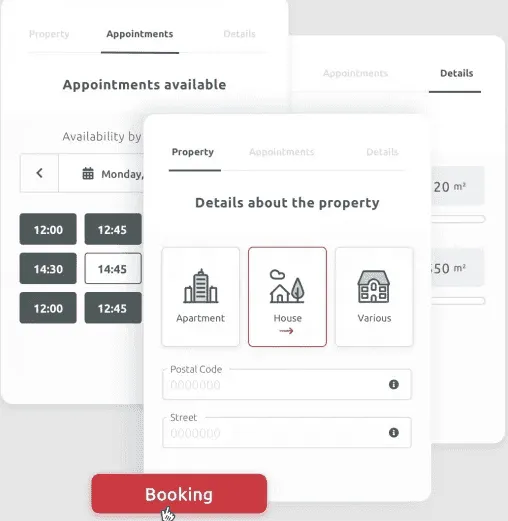
Automated booking workflows illustration

TIMIFY replaces manual appointment coordination with structured, automated booking workflows. Instead of relying on back-and-forth communication, prospects can select available time slots directly where they find the offer, making it faster and easier to move from initial interest to confirmed appointment.

This not only reduces administrative effort for real estate teams but also shortens response times, a critical factor when dealing with high-intent leads in competitive property markets.

Managing complex scheduling across properties, agents, and services

Complex scheduling management illustration

Real estate appointment scheduling involves more than just availability. It requires coordinating multiple variables, including the property, the responsible agent, and the type of interaction across the entire customer journey. Even at this stage, the coordination effort can quickly become overwhelming for real estate agents and their teams. When listings and agents are spread across multiple cities, this complexity increases exponentially.

TIMIFY brings this complexity into one system by aligning availability across these factors. Whether it is a viewing, consultation, or follow-up, each booking is structured in a way that ensures both a smooth customer experience and operational accuracy behind the scenes. TIMIFY helps reduce coordination effort, enabling real estate teams to focus on what matters most: their customers.

Integrating into existing workflows while improving the customer experience

Workflow integration illustration

To ensure adoption across teams, TIMIFY integrates seamlessly into existing workflows. Agents can manage appointments through familiar tools such as Outlook, receiving booking updates without needing to switch systems.

At the same time, businesses benefit from a consistent and professional booking experience. Clear availability, faster scheduling, and a smoother transition from online interest to personal interaction help build trust early and support stronger conversion outcomes.

Example: embedding scheduling into a real estate platform via API

While TIMIFY offers strong out-of-the-box scheduling capabilities, it can also be integrated more deeply into existing platforms.

For example, one large real estate platform embeds TIMIFY directly into the property journey via API. When a user expresses interest in a listing, they can move seamlessly from the property page into a booking flow.

In this setup:

  • the appointment is linked to the specific listing
  • the responsible agent is automatically assigned
  • availability reflects both the agent and the property
  • relevant listing details (such as address or price) can be displayed during booking

At the same time, agents receive notifications and manage appointments through their Outlook calendars, ensuring they remain within their existing workflow.

This type of integration shows how real estate appointment scheduling can become a natural extension of the digital property experience, rather than a separate process.

Conclusion: turning scheduling into a competitive advantage

As digital experiences continue to shape expectations in real estate, the ability to move quickly from interest to appointment is becoming a key differentiator.

Real estate businesses that rely on manual coordination risk slower response times, operational inefficiencies, and missed opportunities.

By contrast, those that adopt structured solutions like TIMIFY can:

  • reduce administrative effort
  • improve customer experience
  • scale their operations more effectively
  • and create a more seamless journey from inquiry to interaction

Because in real estate, a strong first impression does not start at the viewing.

It starts the moment someone books time with the right expert.

Frequently Asked Questions (FAQs)

What is real estate appointment scheduling?
Real estate appointment scheduling refers to the process of organising and managing meetings between agents and clients, such as property viewings, consultations, or valuation appointments. A structured system helps streamline these interactions and ensures faster, more efficient communication throughout the property journey.
What challenges do real estate businesses face with appointment scheduling?
Many real estate businesses struggle with manual coordination, slow response times, and difficulty aligning availability across agents, properties, and appointment types. As operations scale across multiple listings or locations, these challenges can lead to missed opportunities and inefficiencies.
Can real estate appointment scheduling be integrated into property platforms?
Yes, real estate appointment scheduling can be integrated directly into property platforms using APIs. This allows users to book appointments directly from listing pages, creating a seamless transition from interest to interaction and improving the overall digital experience.
Why is real estate appointment scheduling important for agents?
Efficient real estate appointment scheduling reduces manual coordination, speeds up response times, and improves the overall customer experience. It allows agents to focus more on client interactions rather than administrative tasks, which can directly impact conversion rates and client satisfaction.
How does TIMIFY improve real estate appointment scheduling?
TIMIFY automates booking workflows, allowing prospects to schedule appointments directly based on real-time availability. It connects agents, properties, and services in one system, reducing coordination effort while creating a smoother and more professional booking experience.
How does automated appointment scheduling impact customer experience in real estate?
Automated real estate appointment scheduling makes it easier for clients to book appointments quickly and conveniently. Faster response times, clear availability, and a streamlined booking process help build trust early and create a more positive first impression.

About the author

Lukas Alberter

Lukas embarked on his professional journey after earning a Bachelor and Master's degree in Learning Sciences and Educational Research and Management at Ludwig-Maximilians-Universität München. With hands-on experience across HR, recruitment, and educational roles—from tutoring to shaping hiring and organizational strategy at Limehome and Diakonie Rosenheim—he joined TIMIFY in a People & Culture capacity, where he now thrives as P&C Manager. Blending his academic background in learning systems with real-world HR initiatives, Lukas is dedicated to crafting an enriched workplace culture and employee experience at TIMIFY.

Related articles

The Future of Real Estate: How Time Management Apps and Technologies Are Shaping the Industry
Learn more
The Future of Real Estate: How Time Management Apps and Technologies Are Shaping the Industry
Learn more
A broker holding keys and a small house next to the Smart Links app interface
The Scheduling Chaos of Property Viewings – and How Smart Links Brings Order
Learn more