Your Next Appointment Is Already Waiting: Turning Cancellations into Bookable Capacity

A photo of Konstantin
By Konstantin Belev
Updated: Published:

Last-minute cancellations do not have to mean lost capacity. Learn how TIMIFY’s Early Slot Waitlist connects newly available appointments with customers who want to book sooner, helping businesses reduce manual work and improve appointment utilisation.
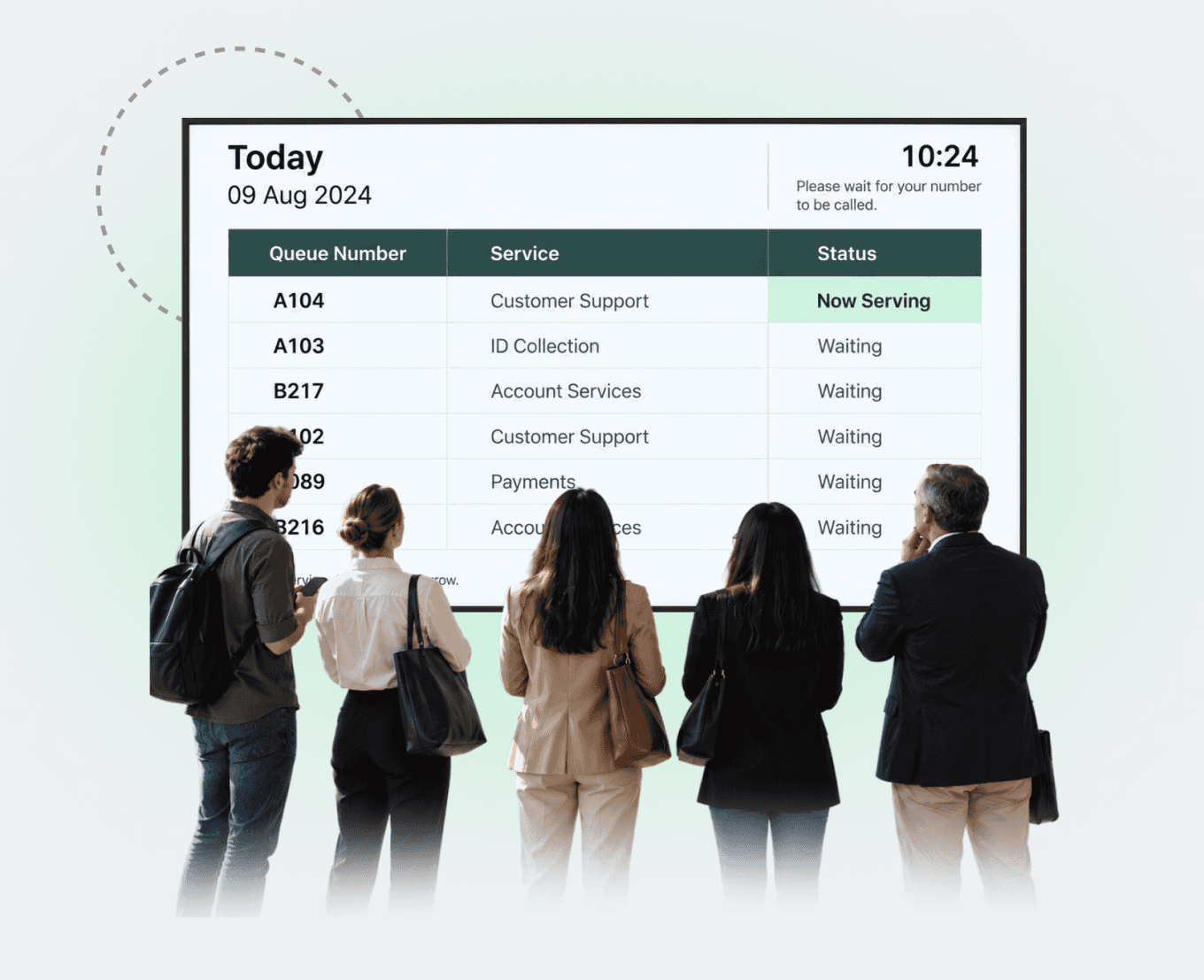
five people standing in front of a big screen, displaying a virtual queue
Back

Last-minute cancellations are a familiar challenge for any business that relies on appointments. A customer changes their plans, a slot suddenly becomes available, and the time that had been reserved for them can be difficult to fill again at short notice.

At the same time, there may already be another customer who would prefer that appointment. Perhaps they booked for next week because it was the earliest available option, but they would happily come tomorrow if given the chance. The demand is there, but the difficulty is quickly connecting it to the newly available capacity.

Traditionally, this has meant relying on manual waiting lists, checking upcoming appointments or contacting customers one by one. TIMIFY’s Early Slot Waitlist provides a more scalable way to manage the process by allowing customers to register their interest in an earlier appointment and to be notified when a suitable opportunity becomes available.

For businesses, this creates another way to respond to cancellations before an appointment slot simply becomes unused capacity. For customers, it offers the possibility of getting the appointment they wanted sooner without having to repeatedly check for availability themselves.

Why last-minute cancellations are difficult to recover

A cancellation does more than remove one booking from the calendar. The employee, room or other resource allocated to that appointment may still be available, but the business now has a much shorter period in which to make use of that capacity.

The impact of missed appointments and short-notice cancellations on resource utilisation is well documented in appointment-based environments. Research into scheduling systems, particularly in healthcare, has shown how unfilled appointments can translate into unused staff and resource capacity.

The closer the cancellation is to the appointment time, the more difficult this becomes. Publishing the slot for online booking makes it available again, but that does not guarantee that the customers most interested in an earlier appointment will see it in time. Some may already have a later appointment confirmed and have no reason to return to the booking calendar.

Businesses can, of course, try to contact those customers manually. A receptionist or service team might maintain a waiting list and start calling people when an appointment becomes free. This can be effective on a small scale, but it also requires someone to identify suitable customers, contact them, wait for responses and keep track of who has accepted or declined.

There are several ways businesses can reduce or manage last-minute appointment cancellations, but even with preventative measures in place, some cancellations will always happen. Having a process for what happens after a slot becomes available is therefore just as important.

As appointment volumes grow, the process becomes increasingly difficult to manage consistently. A single cancellation may not require much effort, but repeated across multiple employees, services or locations, manual coordination can become a substantial administrative task. This challenge becomes particularly relevant for organisations that need to manage appointment bookings across multiple locations.

The underlying problem is therefore not simply that a booking has been cancelled. It is the case that newly available capacity and existing customer demand are often managed separately.

Giving customers a way to request an earlier appointment

Many customers who book an appointment for a later date would prefer to come sooner if the right slot becomes available. Until that happens, however, they still need the security of an appointment they know is confirmed.

Early Slot Waitlist allows businesses to accommodate both needs. During the booking process, customers can indicate that they would like to be notified if an earlier appointment becomes available. They keep their existing booking while registering their interest in moving it forward.

This means the business does not need to start identifying interested customers only after a cancellation occurs. The preference has already been captured as part of the booking process, creating a waitlist of customers who are open to an earlier appointment.

For customers, this also removes the need to keep checking the booking calendar themselves. They can make the appointment that currently works for them and still have the opportunity to move it forward if availability changes.

How Early Slot Waitlist works

Once a customer has opted in, Early Slot Waitlist monitors for an opportunity to offer them an earlier appointment.

When a suitable slot becomes available, for example, because another customer has cancelled, an email notification can be sent to customers waiting for an earlier slot. The business can determine how many customers should receive the notification, customise the email and define how long a customer has to respond.
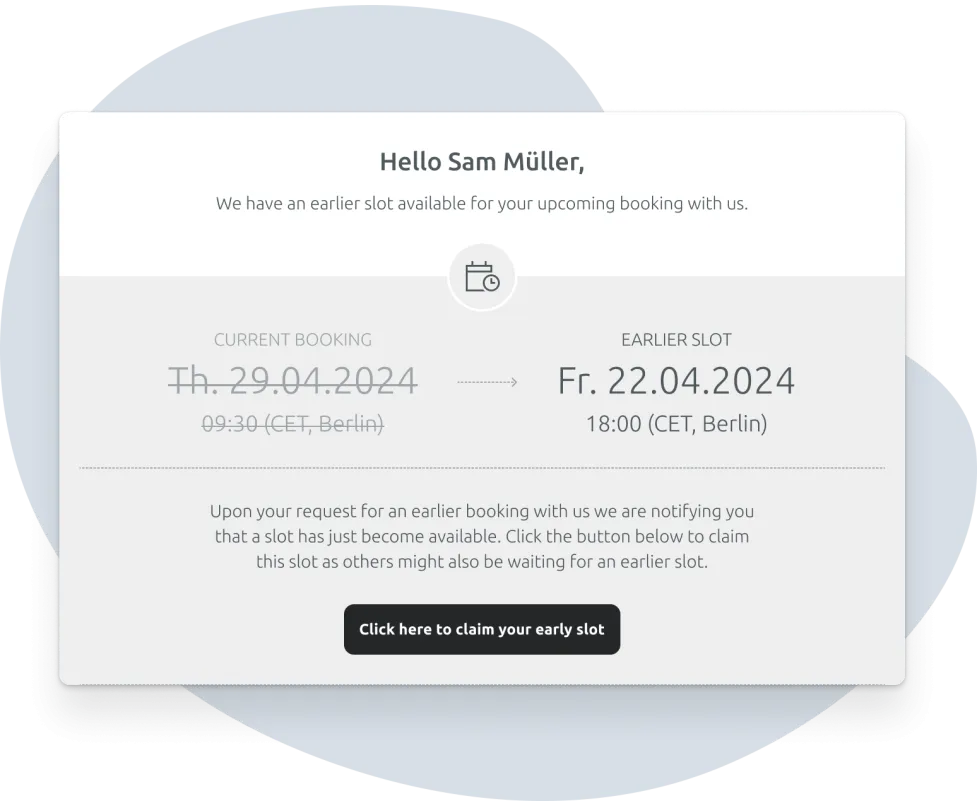
notification for a customer who gets offered an earlier appointment

If the customer does not act within that period, they can be moved to the end of the queue so another customer can take the appointment. Businesses can also define periods during which these notification emails should not be sent.

The process is designed to reduce the amount of manual coordination required when availability changes. Rather than asking an employee to work through a list each time an appointment opens up, the relevant customers can be contacted according to rules that have already been defined.

Importantly, Early Slot Waitlist does not mean that every cancellation will automatically be filled. Whether a newly available appointment is taken will still depend on factors such as customer interest and timing. What it provides is a more direct and efficient way of making that availability visible to customers who have already said they would like an earlier appointment.

Turning cancellations into another booking opportunity

For appointment-based businesses, capacity is perishable. An unused appointment at 10:00 on Tuesday cannot be sold again on Wednesday, which is why recovering availability after a cancellation can have direct commercial value.

Early Slot Waitlist gives businesses another opportunity to put that capacity back into use. Instead of relying solely on new customers discovering the reopened slot, the business can also reach customers who already have a booking and have expressed an interest in coming sooner.

This principle is also supported by research into automated rescheduling. One study examining a digital tool that offered patients earlier appointments after cancellations specifically assessed its ability to fill cancelled slots, improve access to earlier appointments and recover visits that might otherwise have remained unscheduled.

This can be particularly useful when demand is high and customers often book several days or weeks in advance. In these situations, a cancellation does not necessarily indicate a lack of demand for the service. There may be several existing customers who would prefer the newly available appointment; they simply need a practical way to find out about it.

Filling an earlier slot can also free up the customer’s original appointment, making that time available for another booking. In this way, moving one appointment forward can help the calendar respond more dynamically as availability changes.

There is also an operational benefit. Employees do not need to spend the same amount of time identifying candidates, making calls or sending individual messages whenever an appointment becomes free. That is particularly relevant for businesses managing large appointment volumes, where even relatively small administrative tasks become significant when repeated throughout the day.

A more scalable alternative to manual waiting lists

Waiting lists are not new. Many businesses have used them for years to manage customers who want an appointment sooner than the calendar currently allows. The challenge is that traditional waiting lists often depend heavily on employees to keep them up to date and act on them quickly.

Consider a typical manual process. A customer cancels, and an employee checks the waiting list. They contact the first person, but there is no answer. The second customer asks for some time to confirm whether they can make it. A third has already changed their plans but never asked to be removed from the list. Meanwhile, the available appointment is getting closer.

The process becomes more complicated when the business operates several calendars or locations. Teams have to coordinate not only who is waiting, but also which customers are suitable for which openings and who has already been contacted.

Capturing interest during the booking process and automating the subsequent notifications makes the workflow easier to repeat consistently. The business defines how the waitlist should operate in advance, rather than creating a new manual process whenever a cancellation happens.
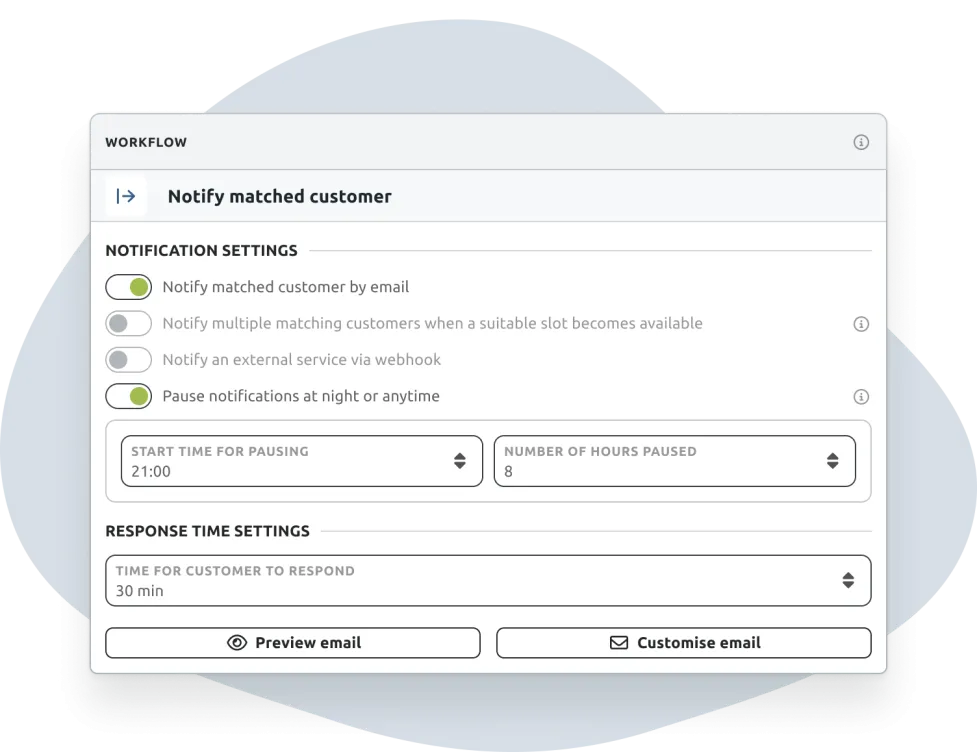
early slot waiting list settings

This does not remove the need for employees to manage exceptional cases or provide personal service where required. It simply reduces the amount of routine coordination involved in matching interested customers with newly available appointments.

Improving the experience for customers as well as businesses

The commercial value of refilling a cancelled appointment is easy to understand, but an Early Slot Waitlist can also improve the booking experience for customers.

When appointment availability is limited, customers often have to choose between accepting a later date or repeatedly checking whether something earlier has opened up. Calling the business to ask about cancellations creates additional work for both sides, and there is no guarantee that the timing of the call will coincide with new availability.

Allowing customers to register their preference once makes the process much simpler. They can keep the appointment they already have, while the business knows that they would be interested in a suitable earlier option.

If one becomes available, the customer receives the opportunity to act on it. If nothing changes, their existing appointment remains in place.

This creates a useful connection between capacity management and customer service. The business has a better mechanism for responding to unexpected availability, while customers gain more flexibility without having to actively monitor the calendar.
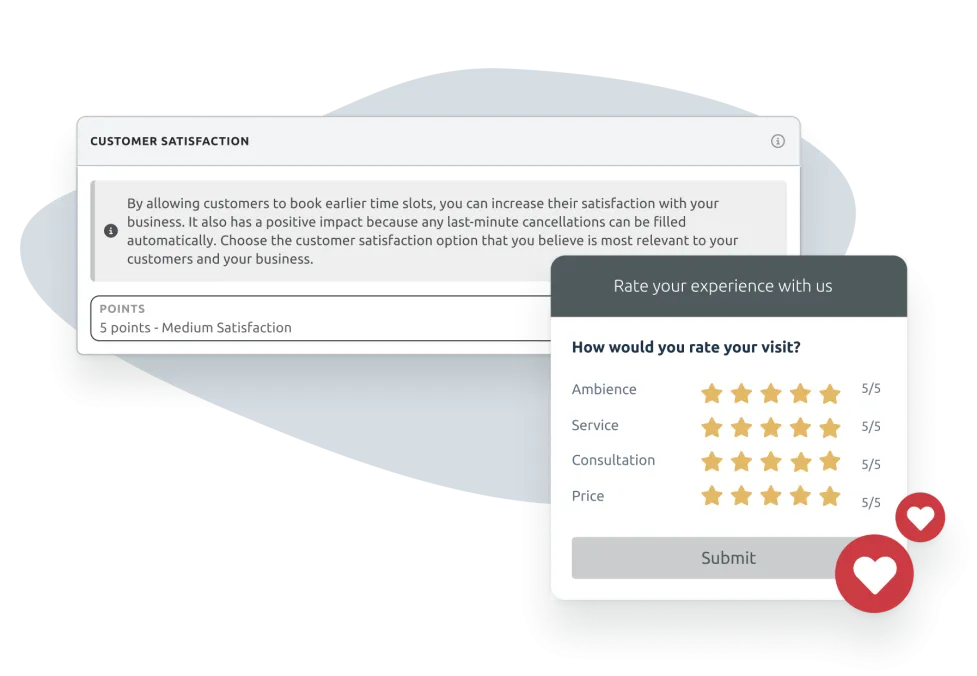
Customer Satisfaction via the TIMIFY Survey App

Using cancellations as part of a broader capacity strategy

No appointment system can prevent every cancellation. Customers will continue to change their plans, and some appointment slots will inevitably become available with little notice.

What businesses can influence is how they respond when that happens.

If newly available appointments simply return to the booking calendar, filling them depends on another customer finding the slot at the right moment. If staff manage the process manually, the business may be able to recover some of that capacity, but at the cost of additional administrative work.

Early Slot Waitlist adds another option. By identifying customers who are interested in earlier appointments in advance, businesses can respond to cancellations with a process that is both faster and easier to scale.

For organisations focused on improving appointment utilisation, that changes the role of a waiting list. Rather than being a passive record of customers who might want an appointment, it becomes an active way of connecting changing availability with existing demand.

Make newly available appointments easier to fill

A cancelled appointment does not always have to become an empty appointment. In many cases, another customer may already be willing to take the slot if they know it has become available.

TIMIFY’s Early Slot Waitlist helps businesses automatically create that connection. Customers can indicate their interest in an earlier appointment when they book, and suitable opportunities can be communicated as availability changes.

The result is a more efficient way to manage cancellations, reduce manual coordination and make better use of bookable capacity while giving customers greater flexibility over when they visit.

The Early Slot Waitlist is currently available to TIMIFY Premium and Enterprise customers via the TIMIFY Assistant private app. To learn how TIMIFY can help your business make better use of cancelled appointments and available capacity, book a demo with our sales team.

Frequently asked questions

What is TIMIFY’s Early Slot Waitlist?
Early Slot Waitlist lets customers register their interest in an earlier appointment while keeping their existing booking. If a suitable slot becomes available, they can be notified automatically.
Do customers lose their existing appointment when joining the waitlist?
No. Customers keep their confirmed appointment while waiting for the opportunity to move it to an earlier time.
Does Early Slot Waitlist guarantee that cancelled appointments will be filled?
No. Filling a cancelled slot still depends on customer interest and timing, but the waitlist creates a faster way to reach customers who want an earlier appointment.
How does Early Slot Waitlist help with cancellations?
When an appointment is cancelled, Early Slot Waitlist can notify customers who have already said they would prefer an earlier slot, making it easier to refill newly available capacity.
Can businesses control how waitlist notifications are sent?
Yes. Businesses can define how many customers receive a notification, customise the email, set a response period and configure times when notifications should not be sent.
Who can use TIMIFY’s Early Slot Waitlist?
Early Slot Waitlist is currently available to TIMIFY Premium and Enterprise customers through the TIMIFY Assistant private app.
A photo of Konstantin

About the author

Konstantin Belev

Konstantin is CRM Manager at TIMIFY, where he oversees all outbound communication with customers across multiple channels. With a keen eye for automation and a strong passion for emerging technologies, he constantly experiments with customer journey flows to optimise engagement and retention. Konstantin thrives at the intersection of data, technology, and human connection—always seeking smarter, more personalised ways to connect with users and enhance their experience.

Related articles

A smiling woman in a beige sweater holding a smartphone, with a floating 3D stopwatch and calendar icon next to her. The stopwatch and calendar are connected by a dotted line, symbolising time management and appointment scheduling.
The Psychology Behind Waiting: The Role of Appointment Scheduling Software
Learn more
Reduce patient waiting times with effective appointment scheduling
Learn more
customer waiting times represented by a sand clock
How to Manage Customer Wait Times to Reduce Customer Frustration
Learn more