Custom Scheduling Software or a Specialized Platform?

Updated: Published:
Explore when building custom scheduling software makes sense, and why a specialized platform often offers greater flexibility, scalability, and lower long-term effort.

Kimon Gerhard
Junior Business Development Manager at TIMIFY
For many businesses, appointment scheduling looks deceptively simple at first.
You need a booking flow, a calendar, some confirmations, maybe a few integrations, and that is it, or so it seems. Especially with faster development cycles, external agencies, and AI-assisted coding, building a custom scheduling solution can appear more realistic than ever.
But in practice, the real question is usually not just build vs. buy. More often, it is: How complex is the use case really, and how much flexibility does the business need over time?
That is where the decision changes.
The market is not really moving from buy to build
Based on conversations with our sales team, most companies are not suddenly deciding to fully build their own scheduling system from scratch.
What they are asking for instead is more flexibility.
They want a solution that can integrate well into their existing systems, fit their processes, and adapt to more complex requirements over time. In other words, they are not looking for a rigid standard tool, but neither are they usually looking to assemble and maintain an entirely custom scheduling platform themselves.
This is especially true for small and mid-sized businesses. For them, a full build project is rarely attractive. The investment, internal coordination, and technical overhead are simply too high compared to the expected benefit.
That leads to a more realistic conclusion: in many cases, the better answer is not build instead of buy, but buy smart. Choose a solution that can be integrated, extended, and adapted.
Why scheduling software looks easier than it really is
Scheduling software often appears simple because users only see the front end: a calendar, a few time slots, and a booking button.
But underneath that surface sits much more logic than most teams initially expect.
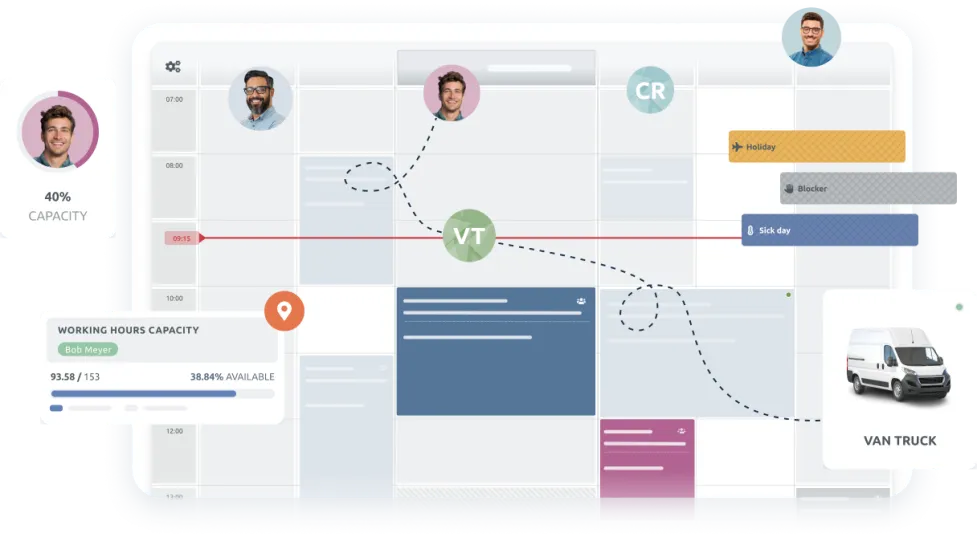
What tends to be underestimated most is that scheduling is not just about displaying availability. It is about managing dependencies, exceptions, changes, communication, and operational rules across multiple moving parts.
As soon as a business has to deal with more than one location, more than one service type, or more than one resource, complexity increases quickly.
Typical challenges include:
- Resource and staff dependencies
- Multiple locations or branches
- Different service durations and availability rules
- Confirmations, reminders, cancellations, and rescheduling
- API connections to existing systems
- Internal workflows and data synchronization
- Ongoing maintenance, security, and updates
What looks like a lightweight booking tool at the beginning can quickly become a mission-critical operational system.
What looks easy at first, and becomes difficult later
There are several parts of scheduling software that seem straightforward at first but become much harder in reality.
Availability logic
Showing free time slots sounds simple. But once availability depends on multiple employees, resources, branches, or service types, the logic becomes much more complex.
Integrations
Many businesses want scheduling to fit into their existing ecosystem — CRM, ERP, retail systems, internal tools, Outlook or Google calendars, websites, and customer portals. This is where off-the-shelf simplicity often ends and real platform thinking begins.
Exceptions and edge cases
Real businesses do not operate in perfect standard flows. There are breaks, last-minute changes, location-specific rules, rotating teams, blocked resources, campaign-based bookings, and internal approval steps. These details are where complexity accumulates.
Ongoing maintenance
Even if a company successfully builds the first version of a scheduling system, the work does not stop there. Software requires continuous maintenance, testing, updates, security oversight, and adaptation to changing operational needs.
That ongoing effort is often where the real cost lies.
When building can make sense
There are cases where building a scheduling solution can be the right decision.
For relatively simple use cases, building may make sense today — especially when a company has strong internal technical capabilities and the scheduling logic is limited in scope.
That can apply when:
- The use case is very narrow and clearly defined
- There are only a few appointment types
- There is little operational complexity
- The business already has a strong product and engineering team
- Scheduling is deeply tied to a proprietary digital product
- The company is prepared to maintain and evolve the system long term
As Emanuel Simon, CEO of TIMIFY, puts it:
“For simple use cases, building can make sense. But once multiple locations, diverse services, and complex resource management are involved, buying a specialized solution becomes the smarter choice.”
— Emanuel Simon, CEO of TIMIFY

That distinction is important. The question is not whether building is theoretically possible. The question is whether it is still the smartest decision once complexity and long-term ownership are taken seriously.
When buying is clearly the better option
Buying becomes the better option as soon as scheduling is no longer a side feature, but a serious operational process.
That is especially true when businesses need:
- Multiple locations or branches
- Complex service and resource management
- Strong integrations into existing systems
- Security and reliability at scale
- Configurable workflows
- Long-term flexibility without building everything from zero
At that point, building internally often means assembling a much larger development effort than initially expected. It is no longer about “just creating a booking flow.” It becomes an ongoing product with technical debt, maintenance demands, and continuous improvement requirements.
This is also why many companies do not actually want a fully custom-built solution. They want a solution that is already proven, but flexible enough to fit their reality.
That is where a platform approach becomes far more attractive.
Buy smart: integration and adaptability matter more than ever
For many businesses, the smartest path is to buy a specialized scheduling solution that can be integrated and adapted instead of trying to build everything from scratch.
This means looking beyond a rigid standard tool and choosing a platform that can:
- Connect via API to existing systems
- Support complex operational setups
- Adapt to different business processes
- Scale as requirements grow
- Reduce the burden on internal development teams
That is also the direction reflected in our sales conversations. Companies are not asking for generic one-size-fits-all software. They want a solution that can fit into their environment and evolve with them.
The real opportunity, then, is not to choose between “standard software” and “fully custom build.” It is to choose a platform that gives businesses the advantages of buying — speed, stability, expertise, and lower long-term overhead — while still allowing the flexibility they need.
The real cost of building is not the first version
One of the biggest misconceptions in the build vs. buy discussion is that the main challenge is creating the first version.
In reality, the first version is often the easy part.
The harder part is everything that comes after:
- Maintaining stability
- Adapting to new requirements
- Managing security
- Handling scale
- Fixing bugs and edge cases
- Supporting integrations
- Keeping the experience reliable for customers and teams
This is why building often requires a larger developer team and a longer-term commitment than expected. What starts as a manageable project can quickly turn into a permanent internal product responsibility.
That may be justified in some cases. But many businesses underestimate how expensive that responsibility becomes over time.
Conclusion: The smartest choice is often not build or buy, but buy smart
For simple, narrow, and well-contained use cases, building a scheduling solution can make sense. New development tools and AI-assisted workflows have made that path more accessible than before.
But once scheduling becomes operationally complex, the logic changes.
Multiple locations, multiple services, resource dependencies, integrations, and long-term maintenance all increase the cost and complexity of building dramatically. In those cases, buying a specialized solution is usually the smarter choice.
The key is to choose a solution that is not rigid, but adaptable.
Because for most businesses, the future is not build instead of buy.
It is buy smart: choose a platform that integrates well, adapts to your processes, and saves your team from having to build and maintain an increasingly complex scheduling product on its own.

That is where specialized solutions like TIMIFY can create the most value, not by forcing businesses into a fixed model, but by combining proven scheduling expertise with the flexibility modern organizations actually need.

Related articles

Company News
Welcome to the Brand New TIMIFY: Your Appointment Scheduling Software

09 September, 2019


Product & Feature
10 Features & Tips to Optimize your Online Appointment Management with TIMIFY
10 October, 2019